The Price Women Pay in the Gender Wars

The latest onslaught in the gender wars, and another final straw in this world full of final straws, comes from the NHS Confederation in their new trans and non-binary guidance for healthcare staff. Published in partnership with the LGBT Foundation, the guidance suggests that no patient is entitled to know the trans status of their carer, that in effect the sex of the health professional can be hidden from the patient if the staff member wishes it.

Patients with dementia are not exempt and ‘should still be challenged’ if they express ‘discriminatory views’, according to the guide – thus fully completing the cycle of female subordination to the trans project between the ages of birth and death. From young girls being told by school trans toolkits that boys in their changing rooms are really girls if they say so, to elderly women with dementia being called discriminatory if they recognise something as familiar as a man standing in front of them, there is something for every stage of life in this new progressive era of female oppression.

From the cradle to the grave there now exists a hydra-like sex-based assault on women’s rights which is increasingly difficult to avoid. You may be setting out on a sporting career, or have worked hard to become an elite athlete, only to find there is a man next to you on the starting line, and you will be told to adjust your sense of reality. Adjust! Adjust your perceptions to view this man, with his puberty-induced advantage, as a woman. You might be in politics, publishing, academia, the arts, science: professional careers full of lists and prizes and incentives for women and girls, and these lists may start to include men and you will be asked to adjust. Adjust! See these men, with the advantages of their male socialisation, as women, or pretend you haven’t noticed.

You might be a victim of rape or a survivor of male violence, and cruelly you will be expected to adjust to a man in your women-only counselling group or refuge. Adjust! Pretend your heightened antennae for maleness does not (should not) exist and if you’re finding that difficult, work harder at ‘reframing your trauma’. You might be in prison, locked up and lacking any means of escape and there might suddenly be a male locked up with you and you will be expected to adjust. Call him a woman and pretend there is no difference between him and the other inmates, it’s what everyone else is doing. There are sanctions if you don’t, and you have no power. Adjust!

You might be an expectant mother and your healthcare provider has started to use language which you find dehumanising, such as birthing parent or lactator. You might be eligible for screening or medical tests but the word ‘woman’ is never used any more so you’re not sure if it includes you or not. You might find yourself in a single-sex hospital ward where suddenly a man is put in the bed next to you. You might prefer a female nurse to do your mammogram, you might have a disability and require female intimate carers. If the female nurse or carer turns out to be a man, you must pretend it doesn’t affect you. It’s normal, your perceptions are wrong, it’s a small thing, it helps other people. Adjust! It is more kind and ‘inclusive’ after all, and anyway if you don’t comply you will be called a bigoted transphobe.

Any situation in day-to-day life where previously there has been an assumption of single-sex provision now requires women to adjust their expectations. Public toilets and changing rooms in shops and leisure centres will now be ‘single-sex’ in a ‘both sexes’ kind of way and you must adjust your feelings accordingly to accommodate any man who says he’s a woman, and increasingly, any man who says he’s non-binary. A natural instinct to mistrust any man who breaks the social code to enter a female space must be repressed. Adjust those natural instincts! Female knowledge and experience of male predatory behaviour needs to be unlearned. Only adjust!

As women, we are very good at recognising a male when we see one, but this ability is now routinely questioned by those intent on blurring the boundaries. The accuracy of our perception (it’s very accurate) is not the point though – the point is that every time we do correctly identify a male, we can now be told we are wrong, on the basis of his inner feelings. We must change our perception and tell his truth rather than our own. Adjust! Adopt his beliefs, not yours.

If you refuse to adjust, or you cannot adjust due to dementia, neurodivergence, a strong sense of material reality, religious beliefs or radical feminism, then the adjustment will be made for you. You will lose friends, jobs, funding, reputation, opportunities, prizes, records, scholarships, careers, and finally the words to say all this. You will probably lose your peace of mind and in extreme cases, your sanity. Women must change themselves or watch their worlds being forcibly changed for them.

This is a wholesale act of discrimination against women. In a society where sex is still an axis of inequality, it was predictable (and predicted) that allowing sex to be a choice would have an adverse effect on the oppressed class. For men the effects are piecemeal, experienced by individuals or smaller sub-groups such as gay men, in individual circumstances. But for women it is structural, it is built in and it exacerbates existing inequalities. The half of the hub of humanity which is female is being slowly turned, cog by cog, further away from equality, further away from safety, further away from fairness, dignity, privacy and comfort, in order to appease a tiny subset of men who wish to be seen as women. They are pulling the lever time and again, ratcheting a bit more, notch by notch, shifting us over, clicking the whole female demographic into a new unwanted, uncomfortable adjustment which we do not like and we did not choose.

We should know by now that when a trans advocacy group writes guidance or gives evidence for legislative change, the rights of women and girls will be ignored. With the passage of time, the lack of will from the authorities to protect women’s rights has become established, and with it, confidence has grown amongst those who would ride roughshod over every piece of legislation designed to level the playing field and promote equality and safety for women and girls.

The great adjustment is demanded of women, not men. The men who benefit from the promotion of ‘progressive’ values know they will not be the ones to pay the price: the consequences will always fall squarely and disproportionately on women.

Why Can’t Women Just Be Nice?

How nice do women have to be?

Well, very, it seems, if we want to hold on to our rights. I’m talking about the rights which are already enshrined in law, by way of the Equality Act 2010, updating and incorporating the sex equality legislation from the Sex Discrimination Act 1975. Rights for women are based on sex, and they always have been, because there is no other legal or material or commonly recognised way of differentiating between men and women. Despite recent assertions from many lobbyists, we have never had to resort to looking inside someone’s pants to distinguish one sex from the other. The common understanding of what male and female categories mean, and the difference between them, has always sufficed to ensure that laws intended to level the playing field for women are actually used to benefit women. They may not always have been adequate to the task, but it’s always been clear who they’re for.

Women are expected to be nice in all walks of life, it’s true, and female socialisation works to prop up this expectation by a system of rewards and punishments as girls grow up. However, recently there has been a ratcheting-up of the demands that women be nice specifically in the arena of defending women’s rights. Being nice has become the number one demand made of feminists, above being fair or knowledgable or determined for example, and I wonder why it’s so important now?

One of the current attacks on women’s rights has taken the form of denying that women exist at all, at least as a distinct category. In normal circumstances this would be laughed out of court but it has gained traction because it has been linked (nefariously) to the supposed oppression of another group (trans people) and the campaign for trans rights has been so successful. To facilitate the demands of trans activists, women have been painted first and foremost as an obstacle to, and gatekeepers of, all the good stuff (including biology itself). The reason that women need sex-specific rights in the first place has been deliberately obscured, minimised and forgotten.

When Alice Roberts, scientist, posts on Twitter an article which posits that somehow, because of clownfish, it is impossible to accurately categorise binary human sex characteristics, feminist Twitter responds en masse. Feminist Twitter includes a lot of scientists and biologists. Many many women gently put Alice Roberts right. Some do it with impatience, some are critical, a tiny minority call her stupid or some such insult, but largely what we get is an astonishingly informative thread about human biology. With lots of evidence. This doesn’t stop people referring to it as ‘a pile-on’ and if Alice Roberts doesn’t post for a few days she will be said to have been ‘hounded off Twitter by trolls.’ Roberts herself says this:

Alice Roberts

When Jo Maughan, barrister, pontificates on Twitter about the right of trans-identified males to be housed in the female prison estate, feminist Twitter also responds. Feminist Twitter is full of lawyers, barristers and law students who really understand the law. They produce an informative thread, disagreeing with Maughan, based on the provisions in the law as it stands. One or two of them get irritated with his refusal to listen or to take on board any points they present as evidence. There might be the odd insult. Largely though the thread is an education on current UK equality law. Maughan thinks these women, rather than presenting their (very knowledgeable) side of the argument, are simply being bigoted:

Jo

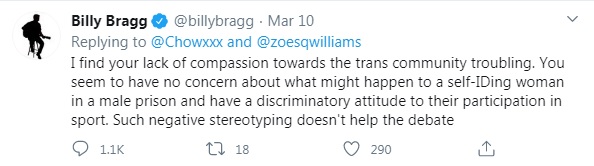
When Billy Bragg, socialist, argues on Twitter for the right of men who identify as women to be included in women-only spaces and sports, feminist Twitter responds again. Feminist Twitter is full of socialist and trade unionist women, grounded in class-based analysis and feminist history. They calmly put Billy Bragg right, based on a socialist analysis of women as a sex class. Occasionally there is a swear word, sometimes a tweeter sounds a bit exasperated, many women express their disappointment with him, but largely Bragg is repeatedly told facts. He responds by telling all these highly intelligent and caring women that they are lacking in compassion:

billybragg

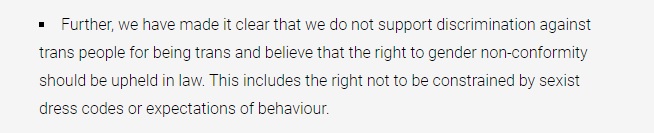
In the years since the 2015 Trans Inquiry, during which trans demands have been promoted and women’s rights have had to be defended, many grassroots women’s groups have grown up to do the work of protecting women in light of the fact that no one else was doing it for them. Over time there have been many meetings, blogs, tweets, speeches, essays, articles and submissions to government enquiries, all from women and women’s groups keen to protect their existing rights. An overriding sentiment, voiced repeatedly, is that trans people should of course have all the rights that everyone else has. Women have bent over backwards to ensure that the defence of women’s rights is in no way seen as a desire to reduce trans rights. All women’s groups want trans people to be free from abuse and to enjoy equal treatment in healthcare, employment and housing, and they frequently say so.

Woman’s Place UK state this:

WPUK

Fair Play for Women are clear on this:

Fair Play

Women and Girls in Scotland say this:

Women and Girls in Scotland

These sentiments are commonly and routinely expressed on social media by individual women too. It could not be clearer that the fight for women’s rights (which means existing rights, already fought for, well-researched and evidenced, and finally won) is not at the expense of trans rights and is not an attack on trans people. In comparison, no trans advocacy group (Stonewall, Gendered Intelligence, GIRES, Mermaids, TELI, Trans Media Watch, Allsorts and countless others) has once expressed the corresponding wish that the changes they are fighting for should not come at the expense of women and girls. There has never, in all their public campaigning, ever been a concern that other people’s rights might be affected by their demands, despite the fact that these demands do involve a rolling-back of women’s rights. To use a technical term, none of them actually gives a shit about women and girls.

This is, after all, what Stonewall, Gendered Intelligence and the Scottish Trans Alliance are fighting for:

Stonewall Trans Inquiry

But nobody is telling them to be ‘nice.’

At the same time as this complete disregard for women’s rights is being promoted as progressive, the insults, abuse and threats, as well as physical assaults, intended to silence women, go unremarked by the same prominent figures who implore women to be nicer, be kinder, be quieter.

The COVID-19 pandemic has shown up in stark relief the need for women to have single-sex spaces to provide refuge from male violence. Domestic abuse has increased markedly during the lockdown all around the world. Other traditional inequalities such as low-paid work and family roles conribute to the worse effect of the lockdown on women. If it wasn’t clear before, it’s clear now: the effects on women of being the subordinate sex according to their ‘gender’ include greater risk, greater violence and greater poverty. These gendered assumptions of the value (or lack of value) placed on ‘women’s work’ are part of the structure of gender that feminists have been fighting forever. We don’t like gender, we reject it and we are not hateful for doing so. It’s sensible; you can see that now. It is gender that disempowers women and girls.

Equally clearly, the coronavirus pandemic has highlighted the sex differences between men and women. Men are much more likely to die from the virus, and this is because of their sex, not because of their ‘gender identity.’ To science and biology deniers, for whom ‘transwomen are women’, the virus tells a different story. Initial studies show that women are more likely to catch the virus, because of their greater exposure, which is a result of the inequality of gendered roles and occupations, but men are more likely to die from it once they do catch it, because of their sex.

Is it still ‘unkind’ to insist that there is a sex difference between men and women and that it is straightforward (and vital) to categorise it? Is it still ‘lacking in compassion’ to analyse and assess a woman’s greater risk of harm according to gendered norms visited on her sex class? Is it still ‘bigoted’ to ask that women continue to be protected in law when these sex and gender differences in outcomes for men and women are now being highlighted so clearly?

Well, apparently yes.

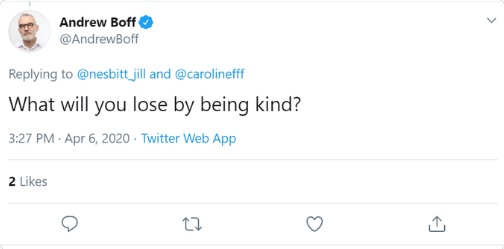
What will you lose by being kind

We have everything to lose, and I’m beginning to think that this is the point. The demand that women be ‘nice’ and ‘kind’ goes further than just being a matter of tone policing, it has an impact on what women are allowed to say, and how much we can expect to be listened to when we say it. Women are not just expected to be nice whilst fighting for our rights, we’re expected to be nice instead of fighting for our rights.

Here’s an idea: just for a change the world could try being nicer and kinder to women.

I am Not and Have Never Been Gender Dysphoric

welding 001

There is an argument around the meaning and relevance of the term gender dysphoria since it has replaced ‘gender identity disorder’ in the medical literature. On the one hand there is a push to remove gender dysphoria from the list of necessary conditions to being assessed as transgender in law, but on the other hand the diagnosis is being jealously guarded by trans activists and allies. In summary the attitude seems to be ‘We may not need gender dysphoria anymore but you sure as hell aren’t going to have it either’. This plays out in the outrage shown towards two main groups of women: those who were tomboys as children and who therefore can see the dangers of extreme trans ideology in schools; and those who have teenage daughters who have suddenly become trans-identified with no warning, and who therefore can see the dangers of an ideology which is subject to social contagion.

So who is qualified or entitled to make a diagnosis of gender dysphoria? Gender dysphoria is defined on the NHS website as being ‘…a condition where a person experiences discomfort or distress because there’s a mismatch between their biological sex and gender identity’. This is sufficiently open to interpretation for many people to take a view on it. On Twitter recently, trans ally Dr Adrian Harrop admonished a woman for calling her early childhood experience ‘gender dysphoria’:

harrop tweet 2

In the same week US journalist Jesse Singal was dismissive of a woman who had written a post on the phenomenon of Rapid Onset Gender Dysphoria, so-called because of the sudden onset of symptoms, usually in teenage girls. The mistake made by Abigail Shrier, according to Singal, was to listen to the mothers of the girls exhibiting these symptoms, and to believe them. Check out the derogatory use of the term ‘a bunch of mothers’.

jesse singaljesse singal 2

I would like to make it clear for my part that I am not, and have never been, gender dysphoric. Far be it from me to self-diagnose.

As a young child I felt like a boy. I rejected dolls. I had my hair cut short, I wore shorts and T shirts and I was mad about football. I played with Scalextric, I climbed trees, I set fire to old car tyres in the woods, I trespassed in other people’s back gardens, I went on adventures. I was not George from the Famous Five, who was just pretending to be a boy, I was William from Just William, or I was one of his Outlaws.

But I did not have gender dysphoria.

I called myself by a boy’s name, I wore boys’ clothes, I became a better football player than most of the boys in my school. One day we had a slideshow in class and one of the slides was of an abattoir. I exclaimed ‘I’d LOVE to visit an abattoir!’ and I expected the boys to agree with me and to look at me in admiration for being tough like them. But they didn’t: they, like the girls, looked at me in disgust. My attempt to perform masculinity had failed. I am still embarrassed, looking back.

I never had gender dysphoria though.

I hated women. Women were weak and pathetic, I was never going to grow up into one of them. I thumped my chest to try to stop any breasts growing. As I reached adolescence I despised the girls in my class who wanted to have babies. I had no maternal instinct whatsoever. Suddenly I was expected to behave ‘like a young lady’ (by my parents) but also to be ‘sexy’ (by my peer group). I developed eating disorders: anorexia and then bulimia. One of my sisters, meeting me off the train, exclaimed when she saw me ‘Oh my God, you’ve got no thighs!’ My other sister when she saw me undress, said ‘You look like a Biafran’. I felt validated. Inside I was Johnny Ramone: now my thighs finally agreed. My periods stopped.

But I didn’t have gender dysphoria.

At art college I learned how to weld. When I put in my order for my own portable arc welder, I was told by the tutor in the sculpture department that I could always swap it for a sewing machine when I left college. After college I got a City and Guilds qualification in Light Fabrication and Welding. At my first job interview I was told welding wasn’t for girls: ‘What if the sparks flew down your top and burned your tits?’ At my second attempt I got a job in a garage but finally left after inadvertently setting fire to a Volkswagen. I learned later that due to the fire risk a welder would always be accompanied by a fire-watcher when welding the underside of a car, but that none of the men who worked there had bothered to inform me or to volunteer. I left because of the humiliation, and the realisation I would never be allowed to fit in.

I was very depressed at this point. I was diagnosed with a depressive illness, and sent for counselling. I still didn’t have gender dysphoria.

Shulamith Firestone in ‘The Dialectic of Sex’ explains the Freudian Elektra Complex in  terms of feminist theory, and examines the pressure on girls to simultaneously identify with the mother and to resist ending up like the mother. This observation about the female child hits home:

This is why she is so encouraged to play with dolls, to ‘play house’, to be pretty and attractive. It is hoped that she will not be one of those to fight off her role till the last minute. It is hoped she will slip into it early, by persuasion, artificially, rather than by necessity; that the abstract promise of a baby will be enough of a lure to substitute for that exciting world of ‘travel and adventure’.

I was one of those girls, like many others, to ‘fight off her role’. The insights of radical feminist and psychological theory would have been more useful in this situation than a gender ideology which places ‘gender’ as an innate quality rather than an outside pressure. Schools do not teach feminist or psychological theory but they do now teach gender ideology from an early age, via trans groups like Mermaids, Stonewall, Allsorts and Gendered Intelligence. If  Mermaids had been around in my childhood, visiting schools with their GI Joe and Barbie gender spectrum theories, I know I would have identified almost 100% with GI Joe, and rejected Barbie in disgust.

the gender spectrum

But still, I know I was not gender dysphoric.

What I also know is that if I had been told at the time that it was possible to have been ‘born in the wrong body’, that my identification with GI Joe (or Just William) meant that inside I might actually be a boy, I would have jumped at the chance to ‘change sex’. It would be like a dream come true: to continue to wear comfortable clothes and have a practical haircut, and to have my skill at football be a positive thing rather than a threat, and to make everybody call me by my boy’s name. Wow! What if that were possible? What power! What excitement! I didn’t want children anyway.

That is how I would have felt as a child.

Trans activists seem to be very angry at the notion that any old tomboy back in the day might have identified as trans given half a chance. This is especially odd considering the current push for self-ID, a notion that the only criteria for a trans identification should be self-declaration. Alongside the claim that a diagnosis of gender dysphoria should no longer be a pre-requisite for trans status, it is strange to see trans activists gatekeeping so furiously. But still, if a doctor can tell a woman she is wrong about her own self-diagnosis on the basis of a couple of tweets, self-ID is obviously not for everyone.

I often see trans activists and allies dismissing the views of women because they are not trans: saying that women who are mothers or lesbians or who used to be tomboys, can have no insight into what the trans experience feels like. But if experiential knowledge is so revered, then my area of expertise tells me a lot about the pitfalls of growing up female in a male-centred world: about body dysmorphia, eating disorders, risk-taking, addiction, self-harming, depression. Teenage coping strategies such as these are being dismissed and minimised if a confusion with gender identity is also present, and it is the trans lobby groups that have successfully pushed for this. My problems as a teenage girl and young adult would have all been swept up as one under gender ideology, much like consolidating a loan. Neat and tidy. One problem instead of six. I would have loved that. It is often said that you can’t make a child trans, as if the concept of being born in the wrong body is a benign idea with no potential to influence or inform. I disagree: I think you can make a child believe they are trans, and that it’s quite simple to do: just make sure all the adults in a child’s world are singing from the same hymn sheet, and ensure there is no access to a different viewpoint. Again, the trans lobby groups have been quite successful at this.

But I did not suffer from gender dysphoria as a child. (Am I allowed to say that?)

What I believe I did suffer from was the confusion that comes from heavily proscribed gender roles and an inability to escape them. Without any consciousness of the larger patterns at work, I was attempting, like many girls, to shift huge weighty blocks of patriarchy all by myself, without any tools. Forcing a way around one block would only ensure another one would heave into view. A good example is culture: it wasn’t much use to me to reject the messages of the popular culture of the time and run full-tilt from Benny Hill, only to find myself slap bang in the middle of the literary clutches of Henry Miller. When gendered expectations are shored up and policed by both individual men and wider institutions, they become nearly impossible to escape. I didn’t know this when I was young. I just thought I was a bit shit.

It is not just a question of being a ‘tomboy’ with a ‘preference’ for masculine things, it can be in some cases a deep identification. Without the perspective of life experience to draw on, or the insights of a feminist analysis, a personal sense of wrongness, felt by many children who don’t fit in, can easily be mistaken for something else. The insistence of trans lobby groups, that affirmation of a child’s self-belief is the only appropriate treatment for a child identifying as the opposite sex, is in fact a belief that children like me should have been diagnosed as trans. An updated Memorandum of Understanding informs all health professionals in the UK that to explore the underlying reasons for a child’s gender confusion is akin to gay conversion therapy. I’m quite pleased looking back that my parents and teachers largely left me alone.

Here is Shulamith Firestone again:

…she rejects everything identified with her mother, ie servility and wiles, the psychology of the oppressed, and imitates doggedly everything she has seen her brother do that gains for him the kind of freedom and approval she is seeking. (Notice I do not say she pretends masculinity. These traits are not sexually determined). But though she tries desperately to gain her father’s favour by behaving more and more in the manner in which he has openly encouraged her brother to behave, it doesn’t work for her.

If we take the brother in this passage to symbolise boys, and the father to symbolise men, it sums up the problem facing girls as they grow up, which for some will result in a male identification of one kind or another. If society does not provide enough of an alternative narrative for girls, it is more difficult to escape the unwanted fate up ahead. I grew up to a backdrop of Benny Hill and Page 3, which was bad enough, but today’s girls grow up to a backdrop of airbrushed perfection, social media and porn culture. There is a crisis in girls’ mental health in the UK, at the same time as an unprecedented rise in the number of girls identifying as boys.

The dehumanisation of girls is made worse by trans culture. Girls can no longer talk about their own bodies or ask for their own safety, privacy and dignity to be respected, for fear of not being ‘inclusive’ enough. Ubiquitous adult porn tells them they are nothing but fuck holes, Teen Vogue calls them ‘vagina-havers’ and ‘non-prostate owners’, trans culture tells them they have a ‘front hole’. Inclusive trans-friendly language means being referred to as bleeders, menstruators, cervix-owners, uterus-havers, egg-producers and non-men. In a masterclass of lack-of-empathy from the Allsorts trans toolkit, in an attempt to cast them as the oppressors of teenage boys, girls are referred to as ‘cis-gendered females’. The problem for girls is not that they identify as boys but that they identify as human in a world which treats women as less than human. When default human equals male, this can sometimes look like the same thing.

My experience of mental health problems as a teenager and young adult may well have looked very much like gender dysphoria to a teacher or counsellor subject to the influence of today’s ‘trans-awareness training’ as delivered by Mermaids, Stonewall, Gendered Intelligence, Allsorts and others. I would certainly have been ready to be convinced. In the despair and isolation I felt at being unable to ‘be who I really was’ in the world in which I found myself, a trans diagnosis would have provided welcome relief from crippling self-blame. I really really wanted ‘all the answers’, lots of young people do. Adults jumping in with ‘answers’ which involve a lifetime of synthetic hormones and medication, surgery, decreased sexual function, and infertility, are not always what young people need, especially as there is so little long-term evidence of the benefits.

It would appear from the evidence that fewer women transition than men, fewer women than men reach middle age and ‘realise’ they have always been the opposite sex, more women than men believe they may have been ‘transed’ mistakenly had trans ideology been around in their childhood, and within the growing detransitioning community there are more females than males. And yet, despite this, there is suddenly an explosion in the number of girls transitioning, and a whole new phenomenon of late-transitioning teenage girls, which has been labelled Rapid Onset Gender Dysphoria. Coincidentally, we have had a decade or so of trans teaching materials and toolkits in schools. It is surely possible that mistakes are being made.

I am not and have never been gender dysphoric.

But trans lobby groups themselves are saying gender dysphoria is no longer necessary to being trans. I might have been, and could have been, diagnosed as trans. Stonewall et al insist that trans people are trans whether or not they have gender dysphoria, or hormones, or surgery, or any kind of treatment at all, at the same time as insisting hormone treatment for children must be started as soon as possible. Trans is now supposedly an identity, relying solely on the say-so of the person concerned. If I had been presented with the option as a child, I may well have self-diagnosed as trans. If I had been encouraged to believe there could be a different sex inside than the one on the outside, it would have made sense to me. It will currently be making sense to many young people. Children are suggestible, and troubled children more so.

In September 2018 Penny Mordaunt announced an inquiry into the sudden rise in the numbers of girls transitioning in the UK. There has been no further update on this inquiry or its methods, but it is essential that this time, unlike the 2015 Trans Inquiry, women are listened to. Trans people may be the experts on trans experience, but women are the experts on female experience, and we are the ones who know best, often through difficult personal experience, all the many reasons why girls today might strongly resist the process of becoming adult human females.



Have Women and Girls Got Too Many Rights?

004

Do you think women and girls have got too many rights? Should some of these be rolled back now? Are we too equal? Too safe? Too represented? Too visible? Too powerful? Do you believe there should now be a reduction in women’s rights? Has it all gone too far? Are women actually the oppressors now? Would you support policies which would curtail some of those rights? Do you believe that women should have fewer rights?

Well, if you do, you’re in good company. It’s not just Men’s Rights groups who agree with you: there are increasing numbers of public institutions and businesses who believe that women and girls are so equal now that we no longer need the legislative and social protections which were fought for and won by previous feminists. We are so safe now we no longer need the provisions in law intended to ensure our safety. We have such a major voice now that we no longer need the mechanisms intended to increase our political representation. We have so much recognition for our work that we no longer need women-only prizes and awards. We are so equal in opportunity to men and boys that we no longer need any special treatment to level the playing field.

Do you agree? Lots of people do.

Women have so many rights in fact that we can afford to share them. We are not yet required by law to share them, but a combination of female socialisation, the post-Trans Inquiry Guide for Service Providers, and a rampant disregard for the Equality Act from trans advocacy groups, means that we are being compelled to share them. Or bullied into sharing them. Or coerced, or guilt-tripped, or emotionally manipulated. There are many ways.

The result of the Trans Inquiry and the Trans Report is that in public life the issue of trans self-ID has essentially all but been decided, without the need for the upcoming government consultation, and without any debate. Many institutions are already putting self-ID into place, and women and girls are already feeling the effects.

GirlGuidingUK for example, have implemented a transgender policy which effectively changes the organisation from being single-sex, and allows trans-identifying boys to share showers, tents and private spaces with girls, without informing parents first. Topshop has designated its girls’ changing rooms as unisex, based on a complaint from one man who identifies as non-binary. Hampstead Ladies Pond has decided to admit trans-identified males, based on self-ID, after they had some ‘trans-awareness training’. Cabins on the Caledonian Sleeper are suddenly to be separated along the lines of ‘gender identity’ rather than sex.

GirlguidingUK, Topshop, Hampstead Ladies Pond and Caledonian Sleeper are just four examples of what is becoming a trend. Businesses know they need to do a bit of diversity training, they get in their local friendly trans group for a trans awareness day, and suddenly the women working there, or the female customers, have fewer rights than they did beforehand. Many other institutions have come to the conclusion that women and girls no longer need the same degree of protection we once did. We have too many rights, we really don’t need them all. Some can surely therefore be removed without the need to consult with us first. A recent example of female protest, in the form of the group ManFriday, resulted in Swim England retracting their new transgender policy in favour of having a consultation. I have yet to come across a company which sees the importance of consulting with women before changing their policies.

In schools there is a definite move towards ensuring that girls grow up with fewer rights than their mothers had. A recent story from Transgender Trend documents the methods used to ensure compliance at one school in Essex, which was coerced into converting its girls’ toilets into unisex toilets, after a campaign led by local trans group Transpire. The Equality Act specifically warns against giving one protected group rights at the expense of another, but when this is trans rights versus girls’ rights, trans groups are ignoring it and misleading schools into putting trans rights first. It is always girls who lose out.

Trans advocacy group GIRES has this advice in their factsheet about trans inclusion:

GIRES factsheet Toilets

The advice to schools provided by LGBT support group Allsorts, in Brighton, follows the same pattern. This is from their East Sussex Schools Toolkit:

This advice was written in 2013 and since then the toolkit has been listed as a resource on the Mermaids website, and used by many schools across Sussex to inform and educate staff on trans inclusion. The aim to teach girls that a boy can be ‘in every other respect a girl’ clearly makes absolutely no sense, and moreover it conflicts with all other initiatives in schools designed to empower girls to respect and assert their own boundaries. It also compromises safeguarding practice. The sentence about the trans pupil’s rights under the Equality Act is a straightforward lie.

In addition to this, girls should get used to the idea of having fewer rights to compete equally in sports:

In a tortured attempt to spin the language, Allsorts believes that girls who object to a male competing with them should be ‘supported to do a different activity’. We all know that that really means ‘be chucked off the team’ though. This is a blatant and intentional misrepresentation of the Equality Act. Girls and women are protected under the category of sex, but trans groups going into schools and workplaces are providing materials which deliberately hide that fact in order to prioritise trans people. Women and girls are always the ones adversely affected.

Trans groups providing guidance for schools and businesses include Mermaids, Gendered Intelligence, GIRES, Educate and Celebrate and the Intercom Trust, as well as Allsorts and Transpire. They all believe that girls and women don’t really need all the rights they currently have, and some of these should be rolled back. It is no longer necessary for girls to enjoy bodily privacy as they grow up, for example, or to expect a level playing field in sporting activities. These are unnecessary cherries on the cake of female equality, and can be removed with no consultation and no impact assessment.

Sport at an elite level fares no better. At the University of Brighton in March, Professor Yannis Pitsiladis introduced a talk by Joanna Harper, at an event entitled ‘Beyond Fairness: The Biology of Inclusion for Transgender and Intersex Athletes’. Harper, a trans-identified male, delivered a shockingly biased talk which suggested no possible disadvantage to women from allowing men into their sports. The research evidence was extremely limited in size and scope, but was nevertheless used to ‘prove’ that there was no physical advantage to be gained from having a male body. Harper suggested that it was ‘traditionalists’ who believed sports should be separated by biology, but that ‘others’ believed gender could be self-identified, as if these two positions carried equal weight, and also as if Team Biology was just a bit old-fashioned.

Professor Pitsiladis had introduced the event as being the first in a series of hopefully informative debates on trans inclusion in sports. If the goal is proper debate then a powerful advocate for trans rights should always be matched with a powerful advocate for women’s rights, as it is always women who will bear the brunt of any changes. This did not happen and there did not appear to be any plans for it to happen in future events. Follow-up reading after the event revealed that Harper’s flawed research was the very research used by the International Olympic Committee to inform their policy on trans inclusion. There are already male trans athletes winning against women in sports such as cycling, boxing and weightlifting. There are already trans sportsmen taking the place of women in team sports such as football, Australian rules football and basketball. The uncomfortable truth is that for every trans person who wins a place on a team there will be a woman who will have lost hers. We can’t just pretend that’s not true.

Once again the views of a minority interest group have been allowed to inform policy which has a profound effect on women, without consulting women first. The IOC obviously take the view that women no longer need a level playing field in sports. We’ve had equality for ages now. For example women’s football is no longer banned by the FA. We have little left to complain about. No, women have had too much equality and too many rights, and some of these are no longer completely necessary, and should be taken away and given to someone else. Women after all are supposed to be good at sharing.

Feminists who have concerns about the erosion of the rights of women are currently being characterised as ‘anti-trans activists’ in an attempt to discredit them. It is clear from the examples above that there are many ways that women and girls lose out when trans rights are given precedence, but there is deliberately no acknowledgement of this from trans activists: it is more useful to them to characterise feminists as haters and bigots than to admit there might be a conflict of interest. In fact, to acknowledge a conflict of interest at all would be to acknowledge that there is a difference between women and ‘transwomen’ and this transactivists cannot do. The law itself does differentiate: it allows sex-based exemptions to the equality law where women’s safety, privacy or dignity is concerned. Biological differences are enshrined in law. Trans activists will never accept this: in their view ‘transwomen are women’. This mantra is used frequently to shut down any argument. Here’s a classic of the genre:

Transwomen are women

The repetition of this mantra is not just used to shout women down, it is also used as a justification for not conducting proper impact assessments. If ‘transwomen’ ARE women then there is clearly no need to look at the impact on women of any change in legislation because changes to help ‘transwomen’ will help women. The purpose of ‘transwomen are women’ is not just to be ‘nice’ to trans-identified males and show solidarity and support, as many people seem to think it is. Its purpose is to deny the whole notion of women having separate rights, because it is in this way that trans activists can get every change they want passed without any opposition. It’s almost as if a Trojan Horse dressed as My Little Pony has landed smack bang right in the middle of the women’s movement and now Men’s Rights Activists are pouring out of it intending to get their own way.

If ever there was a reason for avoiding the language of ‘transwomen’ this is it. Using the phrase ‘trans-identified males’ instead works for women because it serves to clarify the boundaries of the conflicting groups, and leaves no doubt as to the necessity of impact assessments for women and girls before changing legislation for trans people. When most of the rights enshrined specifically for women involve biology to one degree or another, and usually safety, privacy and dignity as well, this is an essential distinction to make. If we are not allowed to make it we can’t fight for our own rights. This is why it has become the preferred language for many women: we have been told ‘transwomen are women’ once too often, and it is never to our advantage.

Feminists are pro-women, not anti-trans. Feminists do not attack and assault trans people, we just know that for women sex-based rights are crucial. When the trans movement is deliberately intent on misleading schools, businesses and institutions, to the detriment of women and girls, the time for being ‘nice’ is over. We have to be honest instead. We have to defend our rights. In every new case of changing trans policy, if there is anyone who needs to budge up, shift over and lose out, it is women and girls. The only way this could be acceptable is if you believe that women and girls have too many rights already. Do you?