The latest onslaught in the gender wars, and another final straw in this world full of final straws, comes from the NHS Confederation in their new trans and non-binary guidance for healthcare staff. Published in partnership with the LGBT Foundation, the guidance suggests that no patient is entitled to know the trans status of their carer, that in effect the sex of the health professional can be hidden from the patient if the staff member wishes it.
Patients with dementia are not exempt and ‘should still be challenged’ if they express ‘discriminatory views’, according to the guide – thus fully completing the cycle of female subordination to the trans project between the ages of birth and death. From young girls being told by school trans toolkits that boys in their changing rooms are really girls if they say so, to elderly women with dementia being called discriminatory if they recognise something as familiar as a man standing in front of them, there is something for every stage of life in this new progressive era of female oppression.
From the cradle to the grave there now exists a hydra-like sex-based assault on women’s rights which is increasingly difficult to avoid. You may be setting out on a sporting career, or have worked hard to become an elite athlete, only to find there is a man next to you on the starting line, and you will be told to adjust your sense of reality. Adjust! Adjust your perceptions to view this man, with his puberty-induced advantage, as a woman. You might be in politics, publishing, academia, the arts, science: professional careers full of lists and prizes and incentives for women and girls, and these lists may start to include men and you will be asked to adjust. Adjust! See these men, with the advantages of their male socialisation, as women, or pretend you haven’t noticed.
You might be a victim of rape or a survivor of male violence, and cruelly you will be expected to adjust to a man in your women-only counselling group or refuge. Adjust! Pretend your heightened antennae for maleness does not (should not) exist and if you’re finding that difficult, work harder at ‘reframing your trauma’. You might be in prison, locked up and lacking any means of escape and there might suddenly be a male locked up with you and you will be expected to adjust. Call him a woman and pretend there is no difference between him and the other inmates, it’s what everyone else is doing. There are sanctions if you don’t, and you have no power. Adjust!
You might be an expectant mother and your healthcare provider has started to use language which you find dehumanising, such as birthing parent or lactator. You might be eligible for screening or medical tests but the word ‘woman’ is never used any more so you’re not sure if it includes you or not. You might find yourself in a single-sex hospital ward where suddenly a man is put in the bed next to you. You might prefer a female nurse to do your mammogram, you might have a disability and require female intimate carers. If the female nurse or carer turns out to be a man, you must pretend it doesn’t affect you. It’s normal, your perceptions are wrong, it’s a small thing, it helps other people. Adjust! It is more kind and ‘inclusive’ after all, and anyway if you don’t comply you will be called a bigoted transphobe.
Any situation in day-to-day life where previously there has been an assumption of single-sex provision now requires women to adjust their expectations. Public toilets and changing rooms in shops and leisure centres will now be ‘single-sex’ in a ‘both sexes’ kind of way and you must adjust your feelings accordingly to accommodate any man who says he’s a woman, and increasingly, any man who says he’s non-binary. A natural instinct to mistrust any man who breaks the social code to enter a female space must be repressed. Adjust those natural instincts! Female knowledge and experience of male predatory behaviour needs to be unlearned. Only adjust!
As women, we are very good at recognising a male when we see one, but this ability is now routinely questioned by those intent on blurring the boundaries. The accuracy of our perception (it’s very accurate) is not the point though – the point is that every time we do correctly identify a male, we can now be told we are wrong, on the basis of his inner feelings. We must change our perception and tell his truth rather than our own. Adjust! Adopt his beliefs, not yours.
If you refuse to adjust, or you cannot adjust due to dementia, neurodivergence, a strong sense of material reality, religious beliefs or radical feminism, then the adjustment will be made for you. You will lose friends, jobs, funding, reputation, opportunities, prizes, records, scholarships, careers, and finally the words to say all this. You will probably lose your peace of mind and in extreme cases, your sanity. Women must change themselves or watch their worlds being forcibly changed for them.
This is a wholesale act of discrimination against women. In a society where sex is still an axis of inequality, it was predictable (and predicted) that allowing sex to be a choice would have an adverse effect on the oppressed class. For men the effects are piecemeal, experienced by individuals or smaller sub-groups such as gay men, in individual circumstances. But for women it is structural, it is built in and it exacerbates existing inequalities. The half of the hub of humanity which is female is being slowly turned, cog by cog, further away from equality, further away from safety, further away from fairness, dignity, privacy and comfort, in order to appease a tiny subset of men who wish to be seen as women. They are pulling the lever time and again, ratcheting a bit more, notch by notch, shifting us over, clicking the whole female demographic into a new unwanted, uncomfortable adjustment which we do not like and we did not choose.
We should know by now that when a trans advocacy group writes guidance or gives evidence for legislative change, the rights of women and girls will be ignored. With the passage of time, the lack of will from the authorities to protect women’s rights has become established, and with it, confidence has grown amongst those who would ride roughshod over every piece of legislation designed to level the playing field and promote equality and safety for women and girls.
The great adjustment is demanded of women, not men. The men who benefit from the promotion of ‘progressive’ values know they will not be the ones to pay the price: the consequences will always fall squarely and disproportionately on women.
I set up the Rad Twin Twitter account in the summer of 2015 in order to illuminate the increasingly outrageous demands of transactivist lobby groups.The point was to be funny whilst doing it, and it was easy: there was so much material to send up: an embarrassment of riches. I shared the password with my twin sister so we could amuse eachother by trying to outdo the other in how outrageously serious we could be in our quest for ‘twins rights.’ In the intervening years the situation depicted by the demands of the ‘twinnywinnies’ has so nearly come to pass that it is sadly no longer funny. There is nowhere to go with this satire. Completely ridiculous demands, such as that twins be allowed to play in goal together in football, or ride a tandem in cycling (because there is #NoAdvantage), no longer work as parody in the era of Laurel Hubbard, Lia Thomas and Emily Bridges.
Along with the decrease in hilarity, ‘trans rights’ have become so divorced from reality and so demanding that, well, ‘twins rights’ start to look like not such a wild idea after all. The comparison between twins and trans is not purely one of alliteration. It can be used to look at the line between a minority group’s expectation that society attempts to accommodate them and their particular needs, and the need to take personal responsibility for your own challenges.
Twins are one of the last minority populations in the world which haven’t yet had a progressive movement dedicated to them, despite the outrageous singleton-normativity of everyday culture and society. Around 1% of the global population is twins, and about a third of these are identical or monozygotic twins. The population is bigger if you include all multiple births, but in any case the size of the identical twin population is roughly comparable to the estimated trans population, at 0.3%. Despite this, sadly, nobody has ever designed us our own flag. Like the trans population, the twins population is growing. The choice of many mothers to delay childbirth, coupled with the rise in the use of IVF treatments, has led to more multiple births, including fraternal twins, triplets and larger multiples. The monozygotic twin population remains stable though, as it is unaffected by either of these trends. (Clearly we are the really special ones…)
Twins are uniquely placed to understand people with gender dysphoria because there is a surprisingly large overlap of concerns. The first and most fundamental is the issue of identity. For people with gender dysphoria it is well-documented that an internal sense of self is experienced as being at odds with the outward body, and that this is interpreted as being about gender. A congruent sense of identity is therefore lost, and whatever your political beliefs about sex and gender, this is undoubtedly a painful and sometimes unbearable experience for a small number of people. We may disagree politically about the best treatment, whether psychological or medical, but the fact remains that it becomes untenable to stay as you are. As a twin, identity is also at the forefront of mental health concerns, although it’s only conjoined twins for whom surgery is an option. The rest of us have to make do with mental health services which have no specialist training and treat twins as if they were the same as two singletons. For some twins the enmeshing of identities is so impossible to live with that the only answer is estrangement. Identical twins will move to the opposite ends of the earth to escape one another and attempt to get away from the insurmountable identity problems which being a twin engenders. It’s really not the same as being two singletons.
The problem for many trans people is that if you don’t pass as the sex you feel you are inside, random strangers are liable to ‘misgender’ you in the street. I understand the pain of being reminded, everywhere you go, of an identity which isn’t yours and which you may have rejected. However, the notion of gender is only one aspect of your identity as a human being, so, however distressing it is, it cannot be quite as annihilating as having your whole identity mistaken over and over again, so that it is your whole person which gets obliterated, not just one aspect of it. Rad Twin would surely claim that twins have it worse. If only we had one of those lovely activist groups working on our behalf, then calling a person by the name of their twin sister would be a hate crime by now, and half the attendees of the Women’s Liberation Conference 2020 would have a criminal record.
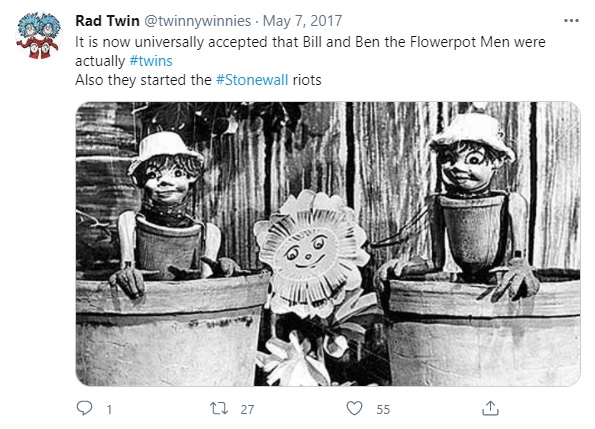
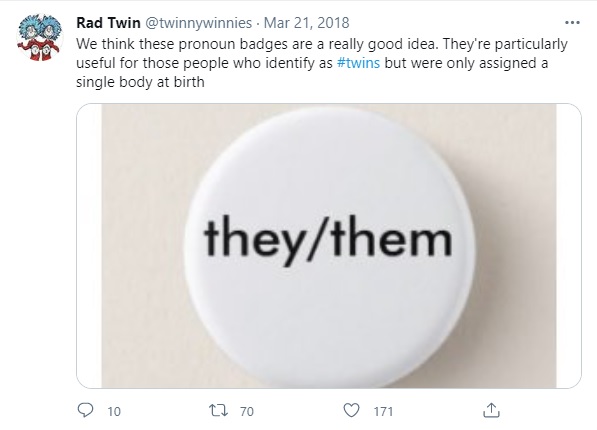
The popular image of twins, particularly children, is mischievous, naughty and cute, which makes it difficult to see a different picture or to get across the downside. To twins themselves growing up, it’s a form of brainwashing. With any other marginalised community we might call it ‘stereotype threat’. So pervasive is the public perception that it seems almost churlish to disabuse anyone of their belief that being a twin is nothing more than having a best friend for life and who wouldn’t want that? Trans people might set great store by their inner ‘identity’ but what if there is no individual inner identity to defend? Brought up on Bill and Ben, Pinky and Perky and Tweedledum and Tweedledee, and dressed identically throughout childhood, it is clear to an identical twin right from the start that the only identity available is as part of a unit. We never hear about Bill, Pinky or Tweedledee on their own. Even the thought of it is slightly embarrassing, somehow inappropriate. So strong is this indoctrination that twins themselves can find it too threatening to contemplate. And don’t even start me on pronouns. Insisting on other people referring to you as she/her is the height of singleton privilege when your pronouns have been they/them for as long as you can remember, entirely without your choosing.
Today’s emphasis on being your ‘true authentic self’ presupposes there is a true authentic self to be. To an extent everybody’s sense of self is a work in progress, but as an identical twin, born and raised as a unit of two, the notion of an authentic self is in itself a prime example of something only singletons can take for granted. Popular psychology in the form of magazine articles, books and agony columns have never been any use to twins, with their emphasis on being ‘who you really are’ and their insistence that you are unique, there is only one you, and therefore you should strive to be yourself rather than copying anyone else. Comparing yourself to others, or the belief that you are being compared, is written into the DNA of identical twins, it’s not a choice. Academic psychology fares no better and has little to say about twins. Some of the more established developmental theories, such as attachment theory, fail to take into account the developmental repercussions of attachment to a twin as well as to the mother. It’s possible that twins develop differently to singletons. Seeking to understand yourself as a twin, you will find there is no informed help out there. Somewhat ironically, if you’re experiencing problems, you’re on your own.
Media representation is a constant bugbear which trans groups campaign about. Just as transsexual males have often in the past been the butt of jokes, identical twins are usually portrayed as a bit of a lightweight gimmick. When twins are not an amusing novelty they are invariably a sinister threat. We go straight from The Shining to Jedward, with very little in between. Trans groups have complained about the lack of trans actors playing trans roles in films and TV but this is nothing compared to the habit of using one actor to portray both twins, such as Tom Hardy playing both the Kray twins in Legend or Lisa Kudrow playing Phoebe’s twin sister in Friends. The lazy cliche of interchangability makes for entertaining viewing, but it is the source of existential crisis for real twins. The most recent culprit was the Norwegian drama series Twin, which not only used the same actor for both twins, but had a storyline which suggested that an identical twin is so identical that even their own families would not be able to tell the difference. This is a completely unrealistic and gimmicky stereotype, but at the same time it is the stuff of nightmares for twins. What is the point of your existence if you are so completely interchangeable with someone else? I don’t know why it isn’t taken more seriously, but it isn’t. People just find it entertaining.
The publishing industry, under great pressure from trans lobby groups and allies, has greatly increased its representation of trans people’s lives, both in children’s literature and books for adults. The same attention is not given to twins. I grew up with old-fashioned stereotypes such as Enid Blyton’s The Twins at St Clares, with its twin-based pranks and mischief. As an adult I progressed on to the casual bigotry of books like Dostoevsky’s The Double:
“Good people live honestly, good people live without any faking, and they never come double.”
The blatant twinsphobia here remains unchallenged to this day and the Society of Authors does nothing.
In representation more broadly twins remain marginalised. Whereas trans people are gaining a higher profile in politics and journalism, twins remain largely unrepresented, apart from in entertainment, where acts such as Bros, the Proclaimers and Jedward capitalise on their USP. The politicians Angela and Maria Eagle are the only twins in public life in the UK who buck the trend. There are no specialist twins groups in political parties, nor even specialist NHS groups or counselling organisations. If you try to find twins support groups you will find many groups designed to support parents of twins and the odd ‘lone twin’ group for people who have suffered a twin bereavement, but nothing for adult twins living in a world made for singletons. You might come across TwinsUK though, which uses twins for research and are therefore the experts, but you will find they have no interest in research which benefits twins themselves, or support for twins or any knowledge of where to look for it. There is a long and disturbing history of twins being exploited for research, and the modern manifestation is obviously benign by comparison. If you have voluntarily contributed to this research there is nothing to complain about, but still it niggles that there is not more recognition in the scientific community that twins themselves might benefit from different areas of research, and that twins too are important. It is still almost impossible to find any quantative data on twins as a distinct demographic.
There has been a recent social media controversy over the role of trans people in the Holocaust: were trans people targetted in the same way that homosexuals were, or were some of the Nazi officers themselves cross-dressers or possibly transsexual? There may be evidence on both sides, but in general the re-writing of ‘trans history’ has been criticised by women’s and gay rights groups, as more and more historical figures have been retrospectively transed despite a lack of evidence. There is no such need to embroider the truth in the history of twins. It is well known that twins were used for medical experiments in the concentration camp at Auschwitz, and uncontestable that social experiments in the fifties and sixties resulted in the deliberate splitting-up of twins and triplets so they could unknowingly form part of research projects. If the definition of oppression is the exploitation of a class of people for the gain of another class, then twins have a realistic claim on a society which has exploited their unique genetic inheritance more or less from the time it stopped killing them at birth. The benefit to singletons has been immense, from medicine to the social sciences to psychology, everyone benefits from experiments on twins and research projects featuring twins. You would have to look a long time before you found a project designed to benefit twins themselves. Nor is there a Twins Day of Remembrance to honour those lost.
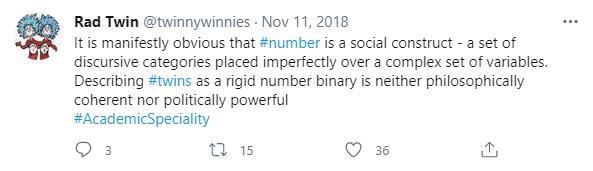
Trans rights groups are always banging on about pronouns. Words conventionally used to denote sex are being repurposed to represent ‘gender’, for the benefit of 0.3% of the population. The demand that people put their pronouns in their email signatures or Twitter bios is defended as a nod to the idea that we cannot always tell someone’s ‘gender’ from their name or appearance, whereas in reality of course we can tell someone’s sex with almost unerring accuracy. This is an unrealistic expectation of the majority. In my quest for my twin identity to be always recognised and honoured I could claim that nobody’s ‘number identity’ should be assumed on a first meeting and that therefore it should become normalised to ask every new aquaintance whether or not they are a twin. Singleton status should not be the default because it ‘others’ those of us who are twins. (I think that this was in fact one of the first demands of Rad Twin on Twitter, and, rather winningly, some of our early allies agreed to it…)
The damage done to minority groups through misrepresentation and marginalisation can be serious. To some extent we are all subject to the pressures of the perceived ‘normality’ of the majority. Minority groups deserve advocacy and deserve to be seen. The reality though is that the majority will always be the default setting, and however hard it is, minority groups cannot expect to become the default themselves. At best they can become more visible and more people will understand them and treat them well. The fun of Rad Twin was in imagining a world where twins became the majority voice in all policies and public discourse. It was funny because it was ridiculous. And this is where I part company with the demands of extreme trans rights groups, who cannot see how unrealistic it is to expect that everybody else resets their instinctual and very human propensity to see and respond to averages and patterns, in favour of the demands of outliers. In reality nobody can live like that. It can be difficult to live as a twin in a non-twin world but the non-twin world is never going to prioritise twinship for my benefit and I wouldn’t presume to demand it. There comes a point where having your every demand indulged only serves to infantalise and you have to learn to stand on your own two feet. Or four.
Being part of a minority group can be a lonely place to be. If you have basic human rights which protect you from discrimination, and support groups which advocate for these rights, then the law on its own cannot do much else for you. It is up to you to find the support you need and to advocate for services particular to your needs and to encourage education which will help with other people’s understanding so that you can live amongst the majority without too much friction. Any more than that and you enter a realm of unrealistic and sometimes ridiculous demands which only serve to alienate well-meaning bystanders who have concerns of their own which they may need to prioritise. Demanding that everybody else must change their language for your benefit or that children must be taught your feelings as fact is a step too far. No amount of empathic understanding warrants the world being turned upside down to benefit one tiny group of people at any other groups’ expense.
To illustrate the point you only have to think about all the identical twins you know, or have ever known in your whole lifetime. Then imagine that all the language you use to describe yourself has to be changed just to keep this tiny group of people happy, and that every new person you meet is just as likely to be a twin as not and you have to check this with them every time before you can even address them. You might begin to feel this is disproportionate, and that’s before we even get to the bit where you have to lose your safe spaces and sports. My sympathy diminishes even more when the ‘gender dysphoria’ part of being trans gets taken out of the equation, as has been lobbied for by all the organisations fighting for ‘self-ID’. Natural empathy for existential identity distress is impossible to extend to the fetishists and fakers now welcomed under the trans umbrella.
Twins of course are not usually beaten up for being twins (except for that one time in primary school when the local thug just didn’t like the look of us…) and we can always pass as singletons if we keep out of eachother’s way. Even Rad Twin would stop short of demanding that twins become a protected characteristic in the Equality Act. Some sensitivity in media representation and entertainment would be accomodating though, and whilst not asking for a 46-page school twins toolkit to explain us to the educational community, some early years policies in education could be of benefit, if only to counteract the ubiquity of the doppelganger myths and cliches identical twins have to grow up with, and to facilitate more understanding from normal people.
In case it seems like I’m complaining, I should make it clear that being an identical twin is obviously the best thing ever. #TwinsIsBeautiful as they say on Twitter (or something like that). You singletons don’t know what you’re missing: for me, life is unimaginable without a twin sister to share it with. The downside though can be brutal. So although the popular conception of twins can sometimes match the reality, it’s not always as much fun as it looks being born in two bodies.
Do you think women and girls have got too many rights? Should some of these be rolled back now? Are we too equal? Too safe? Too represented? Too visible? Too powerful? Do you believe there should now be a reduction in women’s rights? Has it all gone too far? Are women actually the oppressors now? Would you support policies which would curtail some of those rights? Do you believe that women should have fewer rights?
Well, if you do, you’re in good company. It’s not just Men’s Rights groups who agree with you: there are increasing numbers of public institutions and businesses who believe that women and girls are so equal now that we no longer need the legislative and social protections which were fought for and won by previous feminists. We are so safe now we no longer need the provisions in law intended to ensure our safety. We have such a major voice now that we no longer need the mechanisms intended to increase our political representation. We have so much recognition for our work that we no longer need women-only prizes and awards. We are so equal in opportunity to men and boys that we no longer need any special treatment to level the playing field.
Do you agree? Lots of people do.
Women have so many rights in fact that we can afford to share them. We are not yet required by law to share them, but a combination of female socialisation, the post-Trans Inquiry Guide for Service Providers, and a rampant disregard for the Equality Act from trans advocacy groups, means that we are being compelled to share them. Or bullied into sharing them. Or coerced, or guilt-tripped, or emotionally manipulated. There are many ways.
The result of the Trans Inquiry and the Trans Report is that in public life the issue of trans self-ID has essentially all but been decided, without the need for the upcoming government consultation, and without any debate. Many institutions are already putting self-ID into place, and women and girls are already feeling the effects.
GirlGuidingUK for example, have implemented a transgender policy which effectively changes the organisation from being single-sex, and allows trans-identifying boys to share showers, tents and private spaces with girls, without informing parents first. Topshop has designated its girls’ changing rooms as unisex, based on a complaint from one man who identifies as non-binary. Hampstead Ladies Pond has decided to admit trans-identified males, based on self-ID, after they had some ‘trans-awareness training’. Cabins on the Caledonian Sleeper are suddenly to be separated along the lines of ‘gender identity’ rather than sex.
GirlguidingUK, Topshop, Hampstead Ladies Pond and Caledonian Sleeper are just four examples of what is becoming a trend. Businesses know they need to do a bit of diversity training, they get in their local friendly trans group for a trans awareness day, and suddenly the women working there, or the female customers, have fewer rights than they did beforehand. Many other institutions have come to the conclusion that women and girls no longer need the same degree of protection we once did. We have too many rights, we really don’t need them all. Some can surely therefore be removed without the need to consult with us first. A recent example of female protest, in the form of the group ManFriday, resulted in Swim England retracting their new transgender policy in favour of having a consultation. I have yet to come across a company which sees the importance of consulting with women before changing their policies.
In schools there is a definite move towards ensuring that girls grow up with fewer rights than their mothers had. A recent story from Transgender Trend documents the methods used to ensure compliance at one school in Essex, which was coerced into converting its girls’ toilets into unisex toilets, after a campaign led by local trans group Transpire. The Equality Act specifically warns against giving one protected group rights at the expense of another, but when this is trans rights versus girls’ rights, trans groups are ignoring it and misleading schools into putting trans rights first. It is always girls who lose out.
Trans advocacy group GIRES has this advice in their factsheet about trans inclusion:
The advice to schools provided by LGBT support group Allsorts, in Brighton, follows the same pattern. This is from their East Sussex Schools Toolkit:
This advice was written in 2013 and since then the toolkit has been listed as a resource on the Mermaids website, and used by many schools across Sussex to inform and educate staff on trans inclusion. The aim to teach girls that a boy can be ‘in every other respect a girl’ clearly makes absolutely no sense, and moreover it conflicts with all other initiatives in schools designed to empower girls to respect and assert their own boundaries. It also compromises safeguarding practice. The sentence about the trans pupil’s rights under the Equality Act is a straightforward lie.
In addition to this, girls should get used to the idea of having fewer rights to compete equally in sports:
In a tortured attempt to spin the language, Allsorts believes that girls who object to a male competing with them should be ‘supported to do a different activity’. We all know that that really means ‘be chucked off the team’ though. This is a blatant and intentional misrepresentation of the Equality Act. Girls and women are protected under the category of sex, but trans groups going into schools and workplaces are providing materials which deliberately hide that fact in order to prioritise trans people. Women and girls are always the ones adversely affected.
Trans groups providing guidance for schools and businesses include Mermaids, Gendered Intelligence, GIRES, Educate and Celebrate and the Intercom Trust, as well as Allsorts and Transpire. They all believe that girls and women don’t really need all the rights they currently have, and some of these should be rolled back. It is no longer necessary for girls to enjoy bodily privacy as they grow up, for example, or to expect a level playing field in sporting activities. These are unnecessary cherries on the cake of female equality, and can be removed with no consultation and no impact assessment.
Sport at an elite level fares no better. At the University of Brighton in March, Professor Yannis Pitsiladis introduced a talk by Joanna Harper, at an event entitled ‘Beyond Fairness: The Biology of Inclusion for Transgender and Intersex Athletes’. Harper, a trans-identified male, delivered a shockingly biased talk which suggested no possible disadvantage to women from allowing men into their sports. The research evidence was extremely limited in size and scope, but was nevertheless used to ‘prove’ that there was no physical advantage to be gained from having a male body. Harper suggested that it was ‘traditionalists’ who believed sports should be separated by biology, but that ‘others’ believed gender could be self-identified, as if these two positions carried equal weight, and also as if Team Biology was just a bit old-fashioned.
Professor Pitsiladis had introduced the event as being the first in a series of hopefully informative debates on trans inclusion in sports. If the goal is proper debate then a powerful advocate for trans rights should always be matched with a powerful advocate for women’s rights, as it is always women who will bear the brunt of any changes. This did not happen and there did not appear to be any plans for it to happen in future events. Follow-up reading after the event revealed that Harper’s flawed research was the very research used by the International Olympic Committee to inform their policy on trans inclusion. There are already male trans athletes winning against women in sports such as cycling, boxing and weightlifting. There are already trans sportsmen taking the place of women in team sports such as football, Australian rules football and basketball. The uncomfortable truth is that for every trans person who wins a place on a team there will be a woman who will have lost hers. We can’t just pretend that’s not true.
Once again the views of a minority interest group have been allowed to inform policy which has a profound effect on women, without consulting women first. The IOC obviously take the view that women no longer need a level playing field in sports. We’ve had equality for ages now. For example women’s football is no longer banned by the FA. We have little left to complain about. No, women have had too much equality and too many rights, and some of these are no longer completely necessary, and should be taken away and given to someone else. Women after all are supposed to be good at sharing.
Feminists who have concerns about the erosion of the rights of women are currently being characterised as ‘anti-trans activists’ in an attempt to discredit them. It is clear from the examples above that there are many ways that women and girls lose out when trans rights are given precedence, but there is deliberately no acknowledgement of this from trans activists: it is more useful to them to characterise feminists as haters and bigots than to admit there might be a conflict of interest. In fact, to acknowledge a conflict of interest at all would be to acknowledge that there is a difference between women and ‘transwomen’ and this transactivists cannot do. The law itself does differentiate: it allows sex-based exemptions to the equality law where women’s safety, privacy or dignity is concerned. Biological differences are enshrined in law. Trans activists will never accept this: in their view ‘transwomen are women’. This mantra is used frequently to shut down any argument. Here’s a classic of the genre:
The repetition of this mantra is not just used to shout women down, it is also used as a justification for not conducting proper impact assessments. If ‘transwomen’ ARE women then there is clearly no need to look at the impact on women of any change in legislation because changes to help ‘transwomen’ will help women. The purpose of ‘transwomen are women’ is not just to be ‘nice’ to trans-identified males and show solidarity and support, as many people seem to think it is. Its purpose is to deny the whole notion of women having separate rights, because it is in this way that trans activists can get every change they want passed without any opposition. It’s almost as if a Trojan Horse dressed as My Little Pony has landed smack bang right in the middle of the women’s movement and now Men’s Rights Activists are pouring out of it intending to get their own way.
If ever there was a reason for avoiding the language of ‘transwomen’ this is it. Using the phrase ‘trans-identified males’ instead works for women because it serves to clarify the boundaries of the conflicting groups, and leaves no doubt as to the necessity of impact assessments for women and girls before changing legislation for trans people. When most of the rights enshrined specifically for women involve biology to one degree or another, and usually safety, privacy and dignity as well, this is an essential distinction to make. If we are not allowed to make it we can’t fight for our own rights. This is why it has become the preferred language for many women: we have been told ‘transwomen are women’ once too often, and it is never to our advantage.
Feminists are pro-women, not anti-trans. Feminists do not attack and assault trans people, we just know that for women sex-based rights are crucial. When the trans movement is deliberately intent on misleading schools, businesses and institutions, to the detriment of women and girls, the time for being ‘nice’ is over. We have to be honest instead. We have to defend our rights. In every new case of changing trans policy, if there is anyone who needs to budge up, shift over and lose out, it is women and girls. The only way this could be acceptable is if you believe that women and girls have too many rights already. Do you?
A controversy around the subject of trans-inclusion is currently rumbling in the Labour Party: the question of whether trans-identified males, with or without a Gender Recognition Certificate, should be able to access women-only shortlists or become Women’s Officers, or take advantage of initiatives such as the Jo Cox Women in Leadership programme to encourage women into politics. A crowdfunder has been set up to legally challenge the Labour Party’s acceptance (without consultation or debate) of trans self-ID, and there is now a counter-petition accusing all those involved of transphobia. This has been followed by what seems to be a hit-list giving details of Labour members with ‘transphobic’ Twitter accounts, and two women have already been suspended from the party based on this evidence.
What is sometimes forgotten in this argument is the reason that women-only initiatives exist in the first place. AWS and similar schemes are necessary in order to correct a historic imbalance in female representation, but it is not just about helping individual women to pursue a career in politics they may otherwise have been unable to do. The reason women need equal representation is that women have different needs to men and that these are often overlooked by male politicians: when male is the default setting women inevitably lose out.
The status of women as second class citizens is perpetuated by a majority male government who, with the best will in the world, do not always see or consider women’s perspectives on law, healthcare, science, education, crime, and all the other areas of policy which affect women and girls differently to men and boys. The reasons for the sex difference fall into two categories: female biology and female socialisation. Politically we need to talk about, amongst other things: the mental health and aspirations of girls, menstruation and the tampon tax, pregnancy and healthcare, reproductive rights, prostitution and porn, childcare and education, FGM and VAWG, emotional labour and caring, and the menopause and pensions. There is a component of female biology or socialisation, or both, in all these areas, and it is generally accepted that having men make all the policy is not best practice. Not all women feel the same way about any of these areas of policy, but the more women there are in positions of power the more likely it is that they will at least be addressed from a female perspective.
The difficulty when considering transwomen in these posts is that they do not share the two aspects of female experience which inform and prop up inequality – that is, biology and socialisation. However much the desire is there to support trans people within the party, to do so via the use of mechanisms designed to promote women must result in disadvantaging women. Female socialisation ensures that many women will support this, seeing transwomen as women and welcoming their inclusion, but is it fair to do this on behalf of the many other women who are trying to escape the socialisation which tells them to put other people’s needs first?
The mantra ‘transwomen are women’ has been used for years to silence the debate about trans inclusion, but now it is also being used as a form of gatekeeping over who is on the right side of the debate. ‘Do you believe transwomen are women?’ is increasingly being asked as a sort of test of your progressiveness, and there is only one right answer. Many women have been happy up till now to refer to trans-identified males as women, largely out of courtesy and respect, sometimes out of sympathy, but not because it’s actually true. Many of these women now feel that the courtesy and respect has been thrown back in their faces by transwomen acting with what looks suspiciously like a very male sense of entitlement.
The preoccupation with ‘passing’ is an indication that within the trans community itself it is actually acknowledged that transwomen usually look like men. The instinct to recognise sex difference lies very deep within us all, and despite the attempts to discredit feminists, there never was a call for, or a need to, examine someone’s genitals before letting them in to a women-only space. We all know what a man looks like: we can’t not know. It is asking a lot of women to pretend otherwise, but of course we will do so if treated with similar respect in return. What some of us won’t do is be bullied into it.
A good illustration of the attempt to bully women into it was the recent performance of India Willoughby on Celebrity Big Brother. India’s extreme rage and threatening body language, complete with jabbing finger, were very ‘male’ to a woman’s eye. The accompanying repetition of ‘I am … A WOMAN!’ was very like the mantra repeated endlessly on Twitter, and the response from the women was very much that of appeasement towards a violent man. Many of us will recognise that moment when a woman’s expression becomes slightly glazed over in an attempt to do nothing to provoke the man who is angry with her. All the women in the Big Brother House wore that expression. That kind of bullying is employed every day on social media towards gender-critical feminists, and also in real life when feminist meetings are violently disrupted.
If men who identify as women have to go to those lengths to procure compliance then it is very clear they don’t ‘pass’. This means that, when it comes to privilege, they have had the advantage of a lifetime of being seen as male and treated as male. However different you feel inside, the way you are treated depends on what other people can see. However much ‘gender’ is claimed as innate and real, it doesn’t show. Men can have no experience of what it’s like to be a girl growing up, either through socialisation or biology, and this limits how much they can understand the needs of girls and women, even if they identify as women themselves.
Ahead of the recent Women’s March Munroe Bergdorf admonished women for wearing pussy hats because ‘not all women have a vagina’. Bergdorf, a transwoman who ironically benefited from a platform on BBC Woman’s Hour recently to talk about ‘how women are silenced’, tweeted: ‘Centering reproductive systems at the heart of these demonstrations is reductive and exclusionary’. This is an opinion which is mainstream within the trans activist community. (Some of the march organisers tried to ban the wearing of pussy hats after last year’s complaints). If biology itself is seen as exclusionary amongst trans people, then it could be argued that transwomen are actually less useful even than men in representing women politically, because their needs are in direct opposition to women’s.
Coincidentally, it is not the case that transmen are spending much time publicly telling men which body parts they can or can’t talk about, almost as though transmen don’t feel a sense of entitlement over a whole other class of people.
There cannot be a clearer example of how ‘feeling like a woman’ does not necessarily give you a female perspective, and does not give you the ability or experience to represent women’s issues. Notwithstanding all the slogans and mantras in the world, sex will out. If it’s the case that ‘only trans people can talk about trans issues’ (a good reason for aiming for more trans-inclusion in the first place) then it is surely also true that we need more female representation to talk about women’s issues, and that this has to come from women born and socialised female, because otherwise we just defeat the object.
On the eve of a parliamentary debate on the government response to the Trans Enquiry, it might be useful to look at what people mean when they say Transgender. The rights of transgender people are up for debate, and the Women and Equalities Select Committee who hosted the initial inquiry obviously felt that the government’s response did not go far enough in updating these rights, and are seeking to push them further. The government was certainly cautious in its response, and I would suggest this might partly be due to the confusion over terminology. As it stands, trans rights (in terms of ‘gender identity’ becoming a protected characteristic) are in direct conflict with women’s rights (in terms of ‘sex’ being a protected characteristic). Now, we all know what a woman is. (Well, we used to know anyway: a woman is a female of the species, a grown-up one. A girl is an immature member of the female class). But nobody seems to agree on what a trans person is. It is hard to legislate on behalf of a group of people who seem to shape-shift in their own definition (or other people’s definitions) depending on the circumstances.
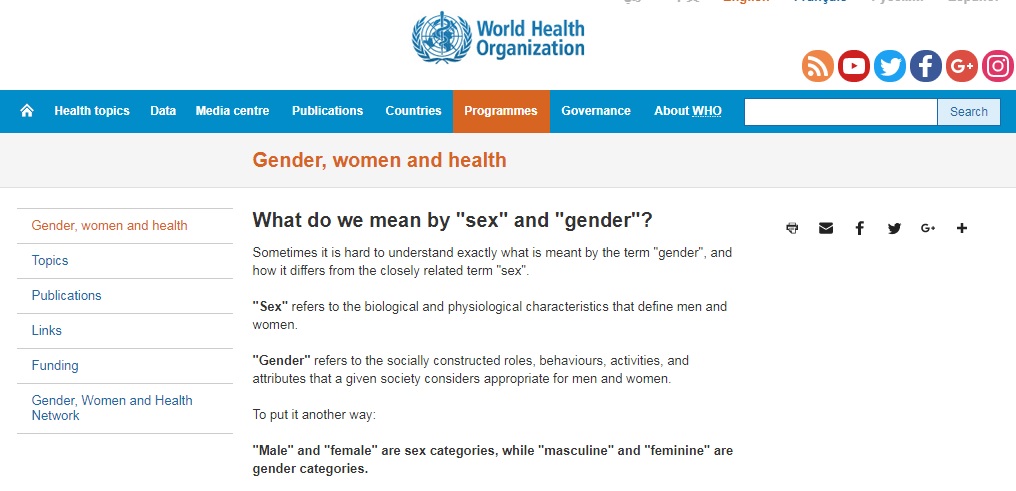
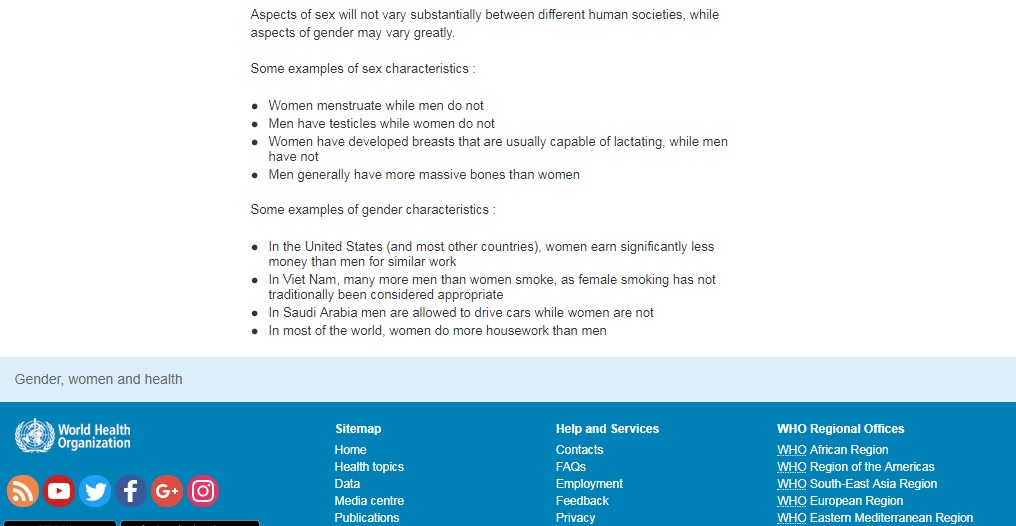
The difference between sex and gender is not always well understood, so here is the definition according to the World Health Organisation (with thanks to @sueveneer on Twitter for flagging this)
Some of us understandably struggle with the idea that a socially-constructed set of characteristics can be experienced as ‘innate’, but this is exactly what the notion of ‘gender identity’ asks us to believe. It becomes even more ludicrous when applied to children, who do not yet have the context in which to understand the world around them, and the way in which it operates to instill social norms. The whole notion of being ‘born in the wrong body’ only makes sense if you believe that certain personality traits are intrinsically linked to certain body types.
Trans activists argue that it is nothing to do with toy choices, hair styles etc, but that trans identity is deeply felt and believed and A REAL THING ON THE INSIDE. This is asserted, notwithstanding that all the kids showing up at gender identity clinics are doing so because they present with ‘non-typical gender behaviour’ ie boys with long hair wearing dresses and girls with short hair who don’t like playing with dolls. These children might also be convinced they should be (or in fact ARE) the opposite sex, but if this conviction alone is used as proof of genuine trans status then the obvious problem is HOW DO THE REST OF US KNOW? And if we can’t tell a genuine trans person from a simply gender non-conforming one, how can we legislate and, if we do legislate, how can we then stay within the law?
To illustrate the problem here are some pictures of men (I use the word to mean adult human male, obviously) who have unconventional gender identity or presentation.
These two people identify as women:
One of these two people identifies as a woman, the other as non-binary:
The two people here identify as male, but also transvestite, transsexual, cross-dressing or transgender as well:
And finally, these two people retain a sense of humour about the whole thing*:
With respect, can the Women and Equalities Commission tell me which of the above people, if any, I should be worried about if they were to enter a public toilet or changing room I was using? (I know which ones I would be worried about, but obviously, it’s not about me…) And can the trans lobbyists tell me which ones are ‘genuine’ trans people who come under the protection of the trans umbrella and which ones do not warrant this protection? And why? And when you say ‘Trans women are women’ which of the above are you talking about? And why?
Because if you can’t answer these questions (and probably, even if you can, because there will be disagreement depending on who you ask) the proposed change in legislation might just as well be “Anyone who feels like it can use the ladies toilet and if you object to that you’re a bigot!” That’s because if the law is changed we will all have to act *as if* the male-bodied person next to us in the changing room is a trans woman or girl, because we are the ones who will be in trouble if we get it wrong: we will be guilty of a hate crime. How to remove at a stroke the rights of women and girls to set boundaries and protect ourselves!
This has never been about demonising trans people, as the lobbyists would have you believe, but about defining trans anti-discrimination legislation in a way that is robust enough to minimise adverse effects and to take account of the risks of exploitation. The proposed changes to the laws surrounding trans equality leave women wide open to abuse, as they remove many of the sex-based protections that help to keep women safe in public life. The fact is that we are on the brink of taking a backwards step regarding the rights of women and nobody seems to be talking about it (except for radical feminists of course, particularly lesbians, who have seen the writing on the wall for a lot longer than most of us).
More details on the disproportionate effect on women that the proposed trans legislation will have can be found here. And to the MPs who will be discussing this in the house next week: before you decide to remove women’s rights in favour of trans rights, please can you tell us what your definition of transgender is, what your criteria will be, and, most importantly, when we are in a public sex-segregated space and feel threatened by the presence of an unexpected male, HOW CAN WE TELL?
*Thanks to Miranda and Hope for letting me use their pictures
Edit: The World Health Organisation has removed its page on the differences between sex and gender so I have inserted the screenshot of the page as it was. I have asked them to show any new evidence which has necessitated a change of information but so far none is forthcoming.











 Not The News in Briefs