Football’s Woman Problem

I haven’t witnessed this much good old-fashioned sexism since the NoMorePage3 campaign brought all the unreconstructed thugs out of the woodwork to call us ugly jealous prudes for wanting a public space for women free of soft porn. Yes, the Spanish women’s football crisis has reminded us that the old forms of sexism haven’t gone away, they’ve just been momentarily overshadowed by the new progressive form of sexism which calls women terfs and bigots for wanting a public space which is safe and fair for women. We’re back momentarily with the men who wouldn’t be seen dead in a ‘This is what a feminist looks like’ T shirt. Their old-fashioned opinion, that women shouldn’t be playing football anyway, now has a very modern public platform for its expression so we can all witness the meltdown of the men who still view the sexually inappropriate behaviour of a man as proof that women should be kept out of the beautiful game. There is a palpable sense of ‘’We told you so!’ in tweets which say things like ‘women are delicate flowers who cannot be around men’ or ‘Women’s football has been a thing for five minutes and they’re already destroying the game with #MeToo’.

I try to avoid making absurd comparisons with extreme regimes, now that feminists are routinely compared to Nazis, but nevertheless there is a continuum between the belief that women should be banned from football for their own good because men will simply not be able to resist assaulting them, to the Afghan Taliban’s restriction on freedoms for women ‘for their own safety.’ Like the periodic suggestion of curfews for women when there is a serial killer on the loose, the punishment and/or control of women for the sins of men is a pernicious form of victim blaming.

Comparisons are being made between the Rubiales kiss and the kisses shared between male footballers, as if the power disparity and women’s experience of sexism make no difference to the experience. It reminds me of the oft-used example of the ‘Diet Coke ad’ during the NoMorePage3 campaign, to suggest that male objectification is on a par with that experienced by females, but men just cope with it better. There is a deliberate sex-blindness where it suits, coupled with a full-on sex-determined judgement on the problem and its solution. We are expected to accept that it’s ‘people’ who kiss eachother (so a man kissing a woman is no different to a man kissing another man), but it’s ‘men’ who play football (so women should back off).

A similar feat of cognitive dissonance is required by the new progressives who will campaign about the issue of consent when a woman is kissed on the mouth but look the other way when a woman is forced to accept the greater risks of playing her sport against a man. For them, there is no difference between males and females when it comes to fairness and safety in sport, but all the difference in the world when it comes to who should be allowed to kiss who without asking permission first.

It is being said that this is Spain’s #MeToo movement, but I rather hope not. #MeToo quickly became defanged by a liberal feminist determination to include men who say they are women in the movement. A woman’s experience of assault then becomes a battlefield between those who decry all male violence against women and those who claim that some men are not really male at all, on their say so alone. A victim can quickly be cast as a bigot in these circumstances, and sympathy for her becomes dependent on a man’s inner feelings about his ‘gender’. Spanish women deserve a better feminism than this, as do we all.

The behaviour of Rubiales towards all the other Spanish team players bordered on creepy: the kiss on Jenni Hermoso’s lips was just the icing on the cake. As a woman, watching all those hugs was quite uncomfortable. An older man in a position of power should be aware of the disparity between his own standing and that of younger women, especially in a game where their acceptance is still a matter of debate. In an (admittedly unscientific) Twitter poll I asked the question of women: ‘Have you ever been made uncomfortable by a hug from an older male relative/friend’s dad etc which felt more like a grope/went on too long/was hard to get away from/was more than just a hug…’ Of the 912 respondents, 89% said yes. There is good reason for women to view Rubiales’ actions differently to men, but even if lived experience didn’t play a part in women’s perceptions, there is still the issue of historic inequalities which are pronounced in the world of football and should be a consideration if women are to be respected in the game. For many years the focus has been on the very basic desire just to be taken seriously in the first place. All the people commenting (sometimes patronisingly) on the status of the England women’s team as ‘inspiration for young girls’ should also be aware of the effect on young girls of watching the disrespectful treatment of those role models by some in the male management of the game.

Like Page3 at the time, treating women as sex objects serves to put women back in their place. It can be a useful tool for men threatened by women encroaching on territory they thought was theirs: it’s a reminder of what they could do to us if they chose. A kiss, a grope, a lascivious stare, in a situation where women are being celebrated for their achievements, is more than just a kiss, it is a statement of who is still boss and it is demeaning to a woman at the very moment of her success.

There has been overwhelming public support for the Spanish women footballers, which is nice to see, though I can’t help feeling that it’s relatively safe ground for the ‘right side of history’ bunch. The old sexists currently having their moment will not last long; the new sexists will reassert themselves eventually, newly confident and patting themselves on the back for decrying the attitude of dinosaurs like Rubiales. Some of them, still too scared to comment on ‘the trans issue’ in sport, but invigorated by this very public opportunity to show off their feminist credentials, might even be dusting down their ‘This is what a feminist looks like’ T shirts. But we won’t be fooled.

Laurel Hubbard and the Olympics Trans Inclusion Policy

In 2015 the International Olympic Committee (IOC) published new guidelines for transgender inclusion in sport, which greatly reduced the previous barriers to males competing in female competition. Former athlete Joanna Harper who, according to the report ‘happens to be trans’, was a major voice in the decision making process, presenting evidence to the committee based on a study of just eight trans athletes. On the strength of this flawed evidence the IOC banished the requirement for sex reassignment surgery and two years of lowered testosterone. Instead, a man could now simply declare his ‘gender identity’ was that of a woman and reduce his testosterone level to 10 nanomoles per litre (nmol/L) for a period of one year before competing. The new guidelines came too late to have any impact on the Rio Olympics of 2016, but made the headlines in 2018 when the Commonwealth Games were held on the Gold Coast.

The controversy surrounded a transgender weightlifter called Laurel Hubbard, a male representing New Zealand in the women’s super-heavyweight category, who had previously won two silver medals at the World Championships in 2017. Hubbard failed in the end to win a medal at the Commonwealth Games, due to injury, but the publicity had served to highlight the IOC’s decision-making processes and prompt some criticism and investigation. The realisation that there was no representation of the rights of female athletes anywhere in the IOC’s process was shocking to many women.

In March 2018 I attended a meeting in Brighton entitled ‘Beyond Fairness: the biology of inclusion for transgender and intersex athletes.’ The meeting was organised by Professor Yannis Pitsiladis of Brighton University, and it platformed Joanna Harper as guest speaker. I wrote about this meeting here and detailed the unevidenced and biased presentation which so angered the group of feminists with whom I attended. The pushback at that meeting, and in subsequent correspondence with Professor Pitsiladis, seemed to represent the first time there had been any direct criticism of Harper’s inadequate evidential influence, because it clearly came as a shock.

The following month it was reported in the Sunday Times and in Pink News that the IOC had halved its testosterone recommendation in a move which would restrict trans inclusion in the 2020 Tokyo Olympics. Joanna Harper claimed some credit for this change to the rules, although a trusted source told us it came about as a direct result of the unexpected backlash at the Brighton meeting. Despite the feeling that a small difference had been made, the result was actually a little meaningless. The normal range of testosterone for females is less than 2nmol/L so the new limit of 5nmol/L for males was still much too high, as well as ignoring the lasting benefits of going through male puberty. It was all beginning to look a little arbitrary.

In 2019 World Athletics (then known as the International Association of Athletics Federations or IAAF) held a meeting on trans inclusion, which was attended by Nicola Williams of Fair Play for Women. In a hostile environment she proved to be a lone voice speaking on behalf of women’s sports. The IAAF then published a press release on transgender eligibility in sport, in which they recommended the new lower level of testosterone as a starting point for individual sports to research and draft their own rules. It was almost as if the buck had been passed by the IOC to the IAAF who had then passed it on to the individual sports federations. Fair Play issued a response to the statement, welcoming the commitment to looking at scientific evidence and formulating fair policies.

That same year saw the voices of some top elite athletes join the debate. Women like Martina Navratilova in the US and Sharron Davies in the UK helped to raise awareness of the unfair burden of ‘inclusion’ on women in sport. The abuse they were subjected to in return was a lesson to any woman currently competing of what might be at stake if they spoke up. It was instructive that to begin with it was only women already retired from their sport who felt able to stick their heads above the parapet. In July 2019 Woman’s Place UK and Fair Play for Women held a joint meeting in London called ‘A Woman’s Place is on the Podium’ which dealt specifically with the subject of a level playing field for women in sport. The speakers were Nic Williams, Sharron Davies, Victoria Hood and Emma Hilton. In the audience was Daley Thompson, one of the first male athletes to speak up in support of women’s sports.

In September that year Fair Play wrote a letter to the IOC and Sharron Davies organised the signatures of sixty top athletes and scientists, urging a suspension of the transgender guidelines in the light of new scientific evidence, until more evidence had been gathered.

In February 2020 World Rugby took the initiative of organising a workshop to look closely at all the evidence available regarding the biological differences between males and females and the potential effect on sporting achievement. It was the largest (and to date, only) conference of its kind, taking into account as it did scientific, medical, legal, social and ethical considerations. As such there were representatives from women’s interests (Fair Play) and trans interests (Gendered Intelligence). A trans scientist (Joanna Harper) was matched by a female scientist (Emma Hilton) and evidence was heard from neutral experts in all the relevant fields. World Rugby produced its report in October 2020 and the results were unequivocal: the advantages conferred by male puberty present a risk to safety and fairness for women which are hardly reduced by any hormone treatment in transition. It would be neither fair nor safe to allow male athletes to compete against female athletes, whatever their gender identity. Fair Play wrote a considered response to the draft guidelines. Joanna Harper was interviewed by Outsports and was slightly less considered:

“Well, frankly, I think they had their minds made up, before they called the meeting,” Harper said.

The trans lobby groups (noteably Stonewall in the UK and ACLU and Outsports in the US) went into overdrive in their condemnation of World Rugby and the alleged ‘banning of trans people from sport’. Despite the evidence showing 20-30% greater risk of serious injury to women in contact sports, our largest LGBT charity encouraged rugby unions across the world to ignore the guidelines, and England Rugby did just that. Their transgender policy stipulates the lower level of testosterone (5 nmol/L) but does not take into account that it is a testosterone-driven puberty which is responsible for the disparity between males and females, and it completely ignores the safety implications. It seemed it was perfectly acceptable for trans groups and supporters to treat women as collateral damage in the quest for trans ‘inclusion’.

In March 2020 the IOC put out a statement to say that new guidelines for transgender inclusion would be made available after the Tokyo games. Due to the Covid 19 restrictions and the subsequent postponement of the games these new guidelines have been delayed by a year. The statement said the IOC had listened to ‘hundreds of athletes, doctors and human rights experts’ but the efforts of women’s groups in the UK and around the world, as well as scientists and female athletes and coaches, meant that this time there was much more evidence of conflicting rights which could not be so easily resolved or ignored. It was reported by the Guardian that the draft guidelines, in which the testosterone levels were supposed to be halved, were now to be shelved, with responsibility being passed on to individual sporting bodies to make their own rules.

In December 2020 a paper was published by Hilton and Lundberg which presented comprehensive scientific evidence of male performance advantage:

“These data overwhelmingly confirm that testosterone-driven puberty, as the driving force of development of male secondary sex characteristics, underpins sporting advantages that are so large no female could reasonably hope to succeed without sex segregation in most sporting competitions.”

New research by our old friend Joanna Harper conceded that a sporting advantage was retained by males identifying as trans, even after three years of hormone therapy. Interviewed about this evidence Harper was predictably reluctant to draw any firm conclusions.

In May 2021 Fair Play wrote to World Athletics to put the case for the new scientific evidence, as a conribution to their ‘global conversation’ about the future of their sport.

The Tokyo Olympics was finally given the go-ahead for July 2021 and Laurel Hubbard qualified to represent New Zealand in the women’s super-heavyweight weightlifting competition. In a statement which perfectly illustrates the fact that consulting ‘human rights experts’ no longer necessarily means you have consulted ‘women’s rights experts’, the IOC publicly praised Hubbard’s ‘courage and tenacity’ and proclaimed that everyone knows that ‘transwomen are women’. The tone of the IOC’s medical and science director, Richard Budgett, came across as annoyed and irritated that things had become so unnecessarily complicated:

“To put it in a nutshell, the IOC had a scientific consensus back in 2015,” he said.

It’s easy to get a scientific consensus of course when you don’t invite any dissenting voices to the table. It seems that the success of women in the last few years in defending women’s sports may have a direct correlation to just exactly how irritated the medical and science director of the IOC appears to be.

A further report from the Guardian’s Sean Ingle brought an admission from the IOC that the trans guidelines are not fit for purpose. Far from admitting that the science was lacking, however, once again Budgett made his own bias absolutely clear:

“There is some research, but it depends on whether you are coming from the view of inclusion as the first priority or absolute fairness to the nth degree being the priority,” he said. “If you don’t want to take any risks at all that anyone might have an advantage, then you just stop everybody. If you are prepared to extrapolate from the evidence there is, and consider the fact the have been no openly transgender women at the top level until now, I think the threat to women’s sport has probably been overstated.”

This seems to be an astonishingly entry-level statement from someone who has purportedly been examining the evidence since 2015.

The IOC 2015 trans guidelines were introduced very quickly, with totally inadequate ‘evidence’, behind closed doors. These guidelines have allowed a male weighlifter in 2021 to take the opportunity of a lifetime away from a female competitor. One missed opportunity for a woman is one too many when the way to keep competition fair is blindingly obvious to almost everyone who looks.

It is frustrating to hear the IOC complain about the compexity and difficulty of the decisions which have to be made in order to take into account fairness for everybody. The subtext here is that it was clearly so much simpler when they didn’t have to listen to women. There were already rules in place which protected women’s sports of course: reserve women’s sports for females. The onus should have been on trans advocates to prove that any changes would not disadvantage an already disadvantaged group, and this proof should have been mandatory before any changes were made. It should not have been up to women to try and roll back a done deal, achieved without their participation.

Many women have been villified, smeared and attacked for standing up for female athletes and defending the rights of women to compete on a level playing field. The IOC have had years to take a considered look at all the evidence and to come to a decision which would protect the rights of everyone. They might have started this process earlier if they had not wasted so much energy fending off women, and they might have sounded less confused about the whole thing if they had approached all the evidence right from the start in good faith and with an open mind.

It should have been completely unnecessary for women to have to fight this battle, in which we are being forced to reinvent the wheel. The Tokyo Olympics has brought a whole new audience to the issue and the IOC will be held to account if they don’t get it right this time.
Who Really Influenced the IOC?

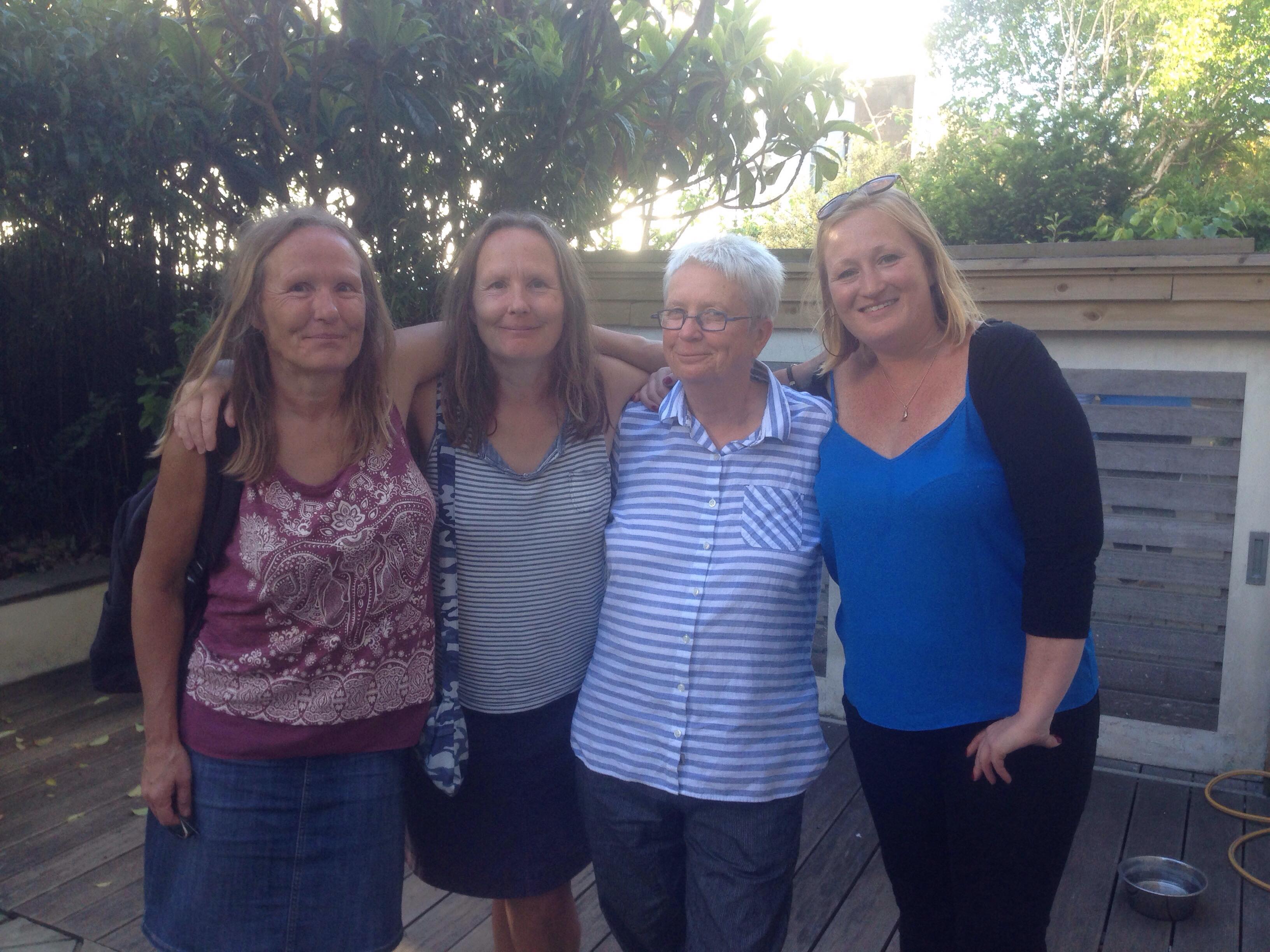
Fierce feministsL-R Stephanie Davies-Arai, Helen Saxby, Sheila Jeffreys, Ali Ceesay. Photo: Anne Ruzylo

Women’s sports and transgender rights are currently in the news, but a recent contribution by Joanna Harper in the Guardian is unhelpfully misrepresentative of many of the facts. Harper talks about ‘respecting the rights of all athletes’ and wanting ‘equitable competition for all’ whilst also recommending a testosterone level for trans athletes which has not been properly researched to ensure fairness. Most outrageously though, Harper claims the credit for a reduction in the testosterone limit by the International Olympic Committee, and argues that the original limit was set too high:

“Paula Radcliffe and others have suggested that the current limit of 10 nanomoles per litre of testosterone (T) for trans women is too high – cisgender (or typical) women are usually under 2nmol/L – and I agree. In 2017, I was on a committee that recommended to the International Olympic Committee that it should reduce the limit to 5nmol/L, and I believe this change will be implemented for next year’s Tokyo Games.”

But the fact is that it was Harper’s own flawed research and presence on the original IOC committee that set the high levels in the first place. Compare this report from January 2016 about the original higher guidelines:

 Joanna Harper, chief medical physicist, radiation oncology, Providence Portland Medical Center, was one of the people at that meeting. She also happens to be trans, and she said her voice in the room was important in determining these guidelines.“The new IOC transgender guidelines fix almost all of the deficiencies with the old rules,” Harper said via email late Thursday night. “Hopefully, organizations such as the ITA will quickly adapt to the new IOC guidelines and all of the outdated trans policies will get replaced soon.”

 The choice of the higher or lower limit of testosterone allowed in transgender athletes begins to look a bit arbitrary. No new research project has been done with trans athletes and no new scientific evidence has been presented to the IOC, so even though a lower limit is obviously preferable, it is still not evidenced. What Harper is actually advocating is using women’s sports as an experiment in how trans inclusion will pan out, whilst at the same time purporting to take a ‘middle ground’.

Here is some background to the story:

In March 2018 I attended an open lecture by Joanna Harper and Professor Yannis Pitsiladis at the University of Brighton, entitled ‘Beyond Fairness: The Biology of Inclusion for Transgender and Intersex Athletes’.  Unaware at the time of who Harper was, I had expected a fairly dry scientific presentation, interesting mostly to students of sports science. What I got instead was a party political broadcast on behalf of the trans lobby. Harper’s presentation was crudely designed to manipulate public opinion. It contained flawed research evidence, an obfuscation of the biological differences between males and females, diversions into weight categories to muddy the waters of sports classifications, and a suggestion that it was old fashioned to still see sex as a binary. Harper’s lecture suggested that testosterone alone was the difference between male and female athletes. No reference was made to the lasting benefits of a male puberty: bone structure, muscle to fat ratio, height, strength, heart rate, lung capacity and all the rest. There are differences in socialisation and external pressures too when you grow up female. Women are not just men with reduced testosterone.

To add insult to injury we were presented with some quite offensive sexual stereotypes based on gendered expectations. We were invited to swoon over a picture of a transman athlete described by Harper as a ‘hunk’, and encouraged to find a transwoman more ‘feminine looking’ than the female athlete also pictured. Fallon Fox was shown standing next to a victorious opponent to suggest there was no advantage, and the difficulties of Hannah Mouncey’s career were described in full, without any mention that both these athletes had injured female opponents. Fox broke an opponent’s eye socket and Mouncey broke an opponent’s leg, but you wouldn’t know it from this lecture.

I attended the meeting in the company of three other feminists from the Brighton area: Ali Ceesay, Stephanie Davies-Arai and Sheila Jeffreys. After the presentation Sheila spoke first from the floor in the Q and A. Introducing herself as a political scientist she launched into a tirade of justified and righteous anger at the complete disregard for women’s rights we had just witnessed. The eloquence of Jeffreys’ fury was a joy to behold. Harper’s shocking response was to flounce. There is no other word for it. Harper ‘flounced’ to the far end of the stage and refused to answer any of the criticisms. Ali Ceesay then had a turn with the microphone, and she too was angry. She  challenged the scientific evidence used by Harper, giving an account of all the physiological differences which benefit all athletes who have been through male puberty. The response from Harper was the same as before: another flounce, another refusal to answer questions. It was quite extraordinary.

Stephanie Davies-Arai and I collared Professor Pitsiladis after the event to talk some more. Professor Pitsiladis was genuine in his desire to hear all sides of the argument and he gave us a lot of his time. He asked us to email him with all the important points we had made, and assured us our views would be taken into account. The points I made to the professor included a concern about male socialisation, which I repeated in my email:

“Further to this, your research into muscle memory was interesting, especially as regards the idea that strength training may have a lasting effect which could be beneficial in later life. You could look at gender in a similar way: that male socialisation and privilege provides men with a bank they can draw on, even after transition, which can give them confidence, a sense of entitlement and a drive to succeed – all attributes seen as natural for males but a little bit less attractive in females. I believe you cannot separate physical attributes of sporting achievement from psychological ones, and that to do so gives you an incomplete picture which favours trans identified males over females.”

Stephanie made the point that female athletes too have difficult choices to make:

“We are all adults, we all have to make choices and sacrifices in life. Some female athletes sacrifice motherhood in order to reach their potential in sport. Some sacrifice sport in order to have children. Some manage to do both, continuing in their sport after pregnancy and childbirth. Men do not face any of these choices or sacrifices. Why should a man who makes the decision to hormonally alter his body to superficially resemble a woman not be expected to make any sacrifice, but to in fact gain advantage in his sport? Clearly female athletes who make the same decision do make a sacrifice as they are unable to compete on a level playing field with men, so why is it that we must do everything we can to accommodate men, even to the extent of sacrificing women’s sport?”

Ali made the point in her email that trans inclusion will always mean women will lose out:

“With every inclusion of a transwoman athlete in sport, (despite the advantages listed above), she failed to acknowledge the experience of dedicated female athletes that missed out on their lifetime dream of competing in order to facilitate this. This is after all the reality: that every biological male competing professionally in a biological class to which they do not physiologically belong, takes the position and opportunity of a biological female.”

You can read the full text of all the emails sent to Professor Pitsiladis here: Helen Saxby  Stephanie Davies-Arai   Ali Ceesay

In contrast to Professor Pitsiladis’ openness to evidence and valid concerns, Joanna Harper just expressed shock that anyone could hold contrary opinions, and seemed to assume that we were transphobic for voicing them. When I subsequently found out the part Harper had played in IOC decision making, I was furious. I had expected that sport, with its wealth, its international power and its plethora of public regulating bodies, would have plenty of people at the top looking out for human rights in general and women’s rights in particular. I assumed scientific rigour would be sacrosanct. I was wrong on both counts. In a global industry which hardly seems to stop talking about doping, there was not one person who stood up for women’s sport when faced with the transgender agenda.

And now, in trans-friendly Brighton of all places, four women had.

The following month it was reported in Pink News that the IOC had changed its rules on testosterone levels, halving the limit to 5 nanomoles per litre.

Joanna Harper is now busy doing some not-so-subtle damage-limitation, possibly because the recent participation of elite sportswomen in the debate has highlighted how much public opinion is on the side of women’s sport. The Guardian article tries hard to present a voice of reason, and includes a claim to have petitioned on behalf of women in the IOC’s latest decision to halve the testosterone levels. The truth is different. Harper had no choice but to back down when faced with the depth and fury of feminist opposition. The impetus for the rethink, according to a source, was a direct result of the Brighton lecture and the response to it.

Who then really influenced the IOC? Was it a transgender athlete who has always campaigned for the inclusion of transwomen in women’s sports, at the expense of a level playing field for female athletes? Or was it in fact down to the righteous fury and concerted input of four fearsome feminists? My female socialisation (obviously) makes it difficult for me to blow my own trumpet, but on behalf of my three comrades in arms… Come on…

Credit where credit’s due.